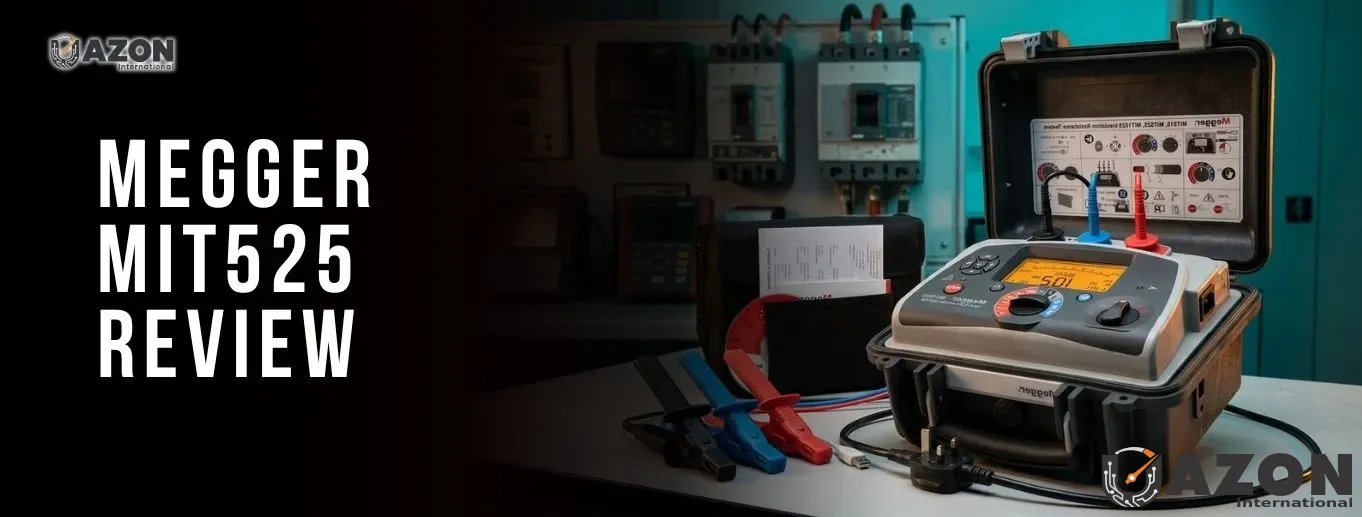
Megger MIT525 5 kV Insulation Tester Review
Table of ContentsUnderstanding High‑Voltage Insulation Diagnostics with the Megger MIT525
Electrical insulation rarely fails suddenly. In most industrial systems it gradually deteriorates due to heat, contamination, vibration, and electrical stress. Detecting that degradation early is one of the most important goals of modern maintenance programs. Instruments such as the Megger MIT525 are designed specifically for this purpose, allowing technicians to analyze insulation condition under controlled high‑voltage testing conditions.
Large motors, power cables, switchgear, and transformers depend on reliable insulation systems. Even minor degradation can increase leakage current and eventually lead to unexpected shutdowns. High‑voltage insulation testers allow maintenance teams to detect these issues early, often long before a catastrophic failure occurs.
Role of the MIT525 in Predictive Maintenance
The MIT525 belongs to a category of test instruments used in predictive maintenance strategies. Instead of simply confirming that insulation resistance meets a minimum threshold, this type of device helps engineers evaluate how insulation behaves over time and under increasing electrical stress.
With selectable test voltages up to 5 kV, the tester can simulate operating stress levels found in medium‑voltage equipment. This allows engineers to identify weaknesses that would remain hidden at lower test voltages.
- Testing insulation condition of industrial motors
- Evaluating power cable insulation integrity
- Preventive testing of switchgear installations
- Commissioning checks for newly installed electrical systems
- Maintenance inspection of generators and transformers
Diagnostic Test Methods Explained
One reason the MIT525 is often used in engineering environments is the range of diagnostic methods it supports. Each testing method reveals a different aspect of insulation performance.
Insulation Resistance (IR)
This is the most fundamental measurement, determining the resistance between conductors and ground at a selected voltage level.
Dielectric Absorption Ratio (DAR)
DAR compares insulation resistance at two different time intervals, helping technicians identify contamination or moisture effects.
Polarization Index (PI)
A longer‑duration test that compares resistance values over time. It is commonly used to assess aging insulation in motors and generators.
Dielectric Discharge (DD)
This diagnostic test evaluates the ability of insulation to retain and release electrical energy after testing.
Step Voltage (SV)
In this method, voltage is increased in stages to evaluate insulation response at different stress levels.
Ramp Test
The applied voltage increases gradually while monitoring leakage current, helping identify weak insulation points that may fail under stress.
Data Recording and Traceability
Modern maintenance programs rely heavily on historical data. Measurements taken today often need to be compared with results recorded months or years earlier. The MIT525 supports this workflow through internal memory and result logging features.
Measurements can be stored directly in the instrument and later transferred through a USB interface. The device also includes a real‑time clock so that stored results are automatically labeled with the correct time and date. When integrated into asset management software, this data helps build a long‑term picture of insulation performance.
Trend analysis is often more valuable than a single measurement. When insulation resistance gradually decreases over several inspection cycles, engineers gain early warning that maintenance or replacement may soon be required.
Megger MIT525 Technical Specifications
| Parameter | Specification |
|---|---|
| Test Voltage Levels | 250 V, 500 V, 1000 V, 2500 V, 5000 V, VL |
| Adjustable Voltage Range | 100 V to 1 kV (10 V steps), 1 kV to 5 kV (25 V steps) |
| Insulation Resistance Range | 10 kΩ to 15 TΩ @ 5 kV |
| Accuracy | ±5% from 1 MΩ to 3 TΩ |
| Diagnostic Test Modes | IR, Timed IR, DAR, PI, DD, SV, Ramp |
| Data Storage | Internal memory with result recall |
| Data Transfer | USB interface for PC / PowerDB |
| Safety Category | CAT IV 600 V |
| Power Source | Rechargeable Li‑ion battery or AC supply |
| Short Circuit Current | 3 mA |
| Voltmeter Range | 30 V to 660 V |
Final Thoughts
High‑voltage insulation testers play an important role in the reliability of electrical infrastructure. By combining multiple diagnostic methods with data logging capability, instruments such as the MIT525 provide engineers with tools to evaluate insulation health rather than simply checking whether it passes a single measurement threshold.
When integrated into a structured maintenance program, the insights gained from these tests can significantly reduce unexpected failures and improve long‑term asset reliability.