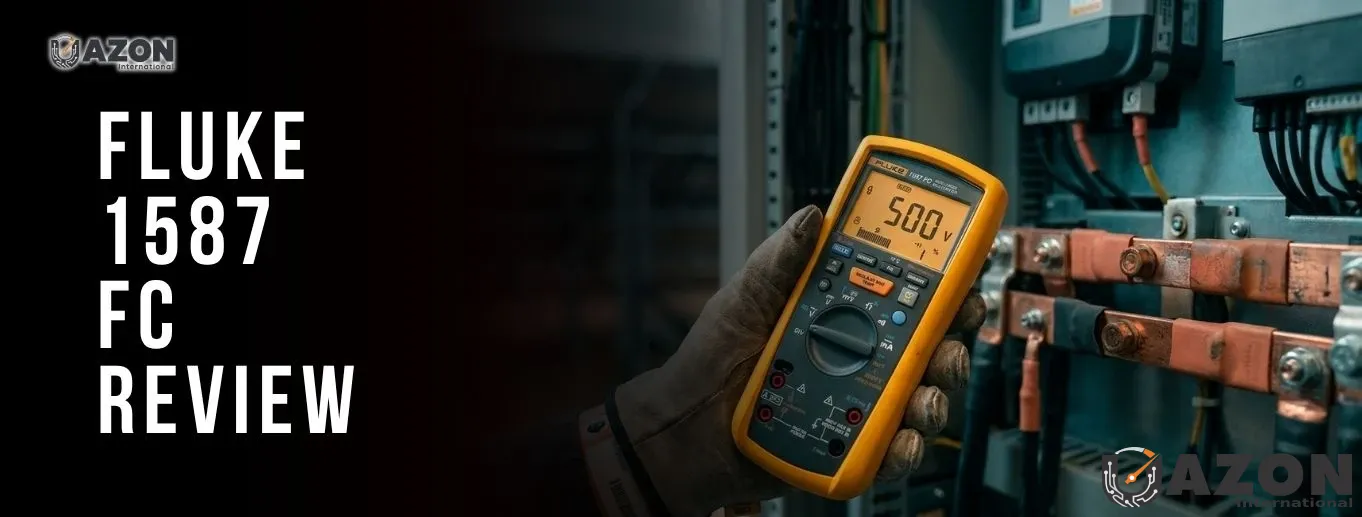
Fluke 1587 FC Review: Insulation Multimeter for Professional Electrical Diagnostics
Table of ContentsInside the Fluke 1587 FC: A Modern Tool for Insulation Diagnostics
A closer look at how insulation resistance testing and digital multimeter functionality work together in one professional troubleshooting instrument.
The Role of Insulation Testing in Electrical Reliability
Electrical systems depend heavily on the integrity of insulation materials surrounding conductors. Over time, insulation can degrade because of temperature stress, mechanical vibration, humidity, or contamination. When this happens, leakage currents increase and equipment performance becomes less reliable.
The Fluke 1587 FC insulation multimeter was designed to simplify the process of identifying these issues. Instead of using separate tools for electrical measurements and insulation resistance testing, technicians can perform both tasks with a single handheld instrument. This combination significantly improves efficiency when diagnosing motors, cables, or industrial equipment.
Key Functional Capabilities
- Integrated insulation tester with selectable test voltages
- True‑RMS digital multimeter for accurate electrical measurements
- Wide insulation resistance range suitable for motors and cables
- Wireless connectivity using the Fluke Connect platform
- Time‑based insulation diagnostics including PI and DAR testing
- Low‑pass filter for accurate measurements in VFD environments
- Live circuit detection that prevents unsafe insulation testing
These features allow maintenance engineers to evaluate electrical systems with greater confidence and reduce the need for multiple test instruments in the field.
How the Combined Design Improves Troubleshooting
Traditional maintenance workflows often require technicians to carry both a digital multimeter and an insulation tester. Switching between instruments can slow down troubleshooting, especially in complex industrial environments.
With the Fluke 1587 FC, technicians can verify circuit voltage, current, and resistance before performing insulation tests. This sequence ensures that circuits are safe and correctly configured before high‑voltage insulation measurements begin.
In addition, the device supports Polarization Index (PI) and Dielectric Absorption Ratio (DAR) tests. These measurements analyze how insulation resistance changes over time, which can reveal moisture intrusion or aging insulation.
Technical Specifications
| Parameter | Specification |
|---|---|
| Insulation Test Voltages | 50 V, 100 V, 250 V, 500 V, 1000 V |
| Insulation Resistance Range | 0.01 MΩ – 2 GΩ |
| Voltage Measurement | AC/DC up to 1000 V |
| Current Measurement | AC/DC milliamps |
| Additional Measurements | Resistance, continuity, capacitance, frequency, diode test |
| Temperature Measurement | K‑type thermocouple |
| Connectivity | Fluke Connect wireless measurement logging |
| Safety Rating | CAT III 1000 V / CAT IV 600 V |
| Power Source | Four AA batteries |
Where This Instrument Is Most Useful
The Fluke 1587 FC is commonly used in environments where insulation integrity and electrical measurements must be evaluated together. Maintenance teams often rely on this type of instrument when working with motors, drives, transformers, and industrial control systems.
- Industrial motor maintenance
- Preventive electrical inspections
- Commissioning of new electrical installations
- HVAC system diagnostics
- Power distribution system troubleshooting
By combining insulation testing with full multimeter capability, technicians can perform a complete electrical assessment using a single device.