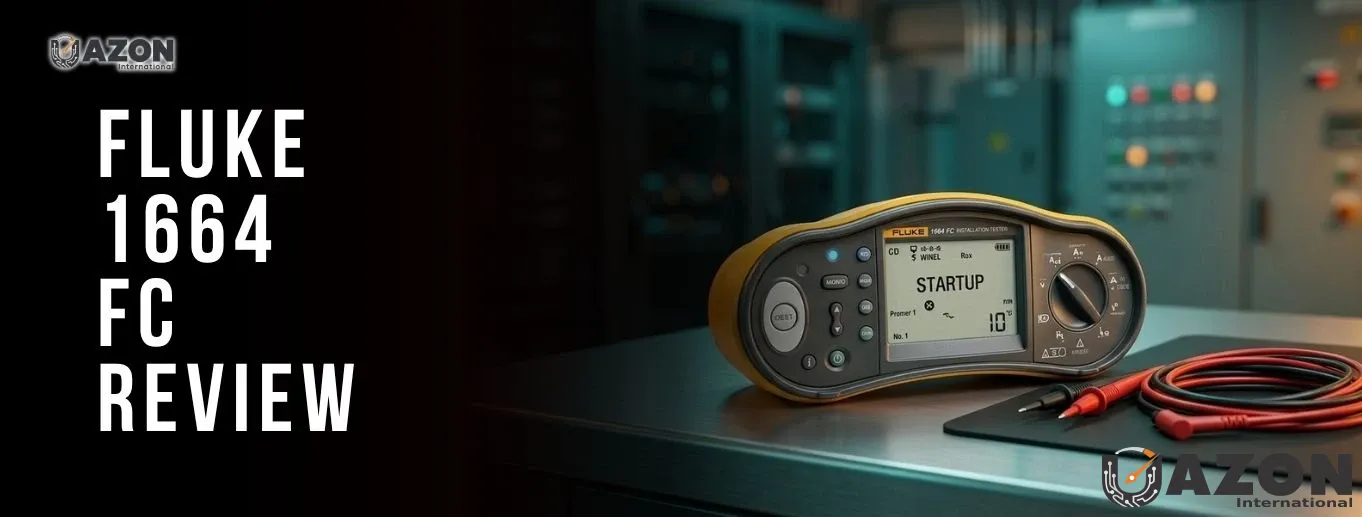
Fluke 1664 FC Installation Multifunction Tester Review
Table of ContentsFluke 1664 FC in Real-World Electrical Workflows: How a Multifunction Tester Changes Installation Testing
A field-oriented technical article examining how the Fluke 1664 FC supports electricians during certification, commissioning, and troubleshooting of electrical installations.
Installation Testing Is a Process — Not Just a Measurement
Electrical installation verification is rarely about performing a single test. In practice, it is a structured sequence: verify supply conditions, confirm protective conductor continuity, measure insulation resistance, check loop impedance, validate RCD operation, and document everything.
The Fluke 1664 FC was designed around this workflow logic. Instead of acting as a collection of separate test modes, it operates as a unified installation testing platform that supports the full certification process.
Reducing Repetition with Auto Test
One of the most practical aspects of the 1664 FC is its Auto Test sequence. In a conventional workflow, technicians manually trigger insulation, loop, and RCD tests step by step. This repetition introduces time overhead and increases the risk of skipped steps.
The Auto Test function executes required installation checks in a single automated sequence. According to the technical documentation, this can reduce overall test time by up to 40%, particularly in environments where repeated distribution board testing is required.
For contractors working across multiple circuits daily, this efficiency gain becomes operationally significant.
Insulation Testing with Built-In Risk Awareness
Insulation testing typically involves applying elevated test voltages — 50 V, 100 V, 250 V, 500 V, or 1000 V depending on the installation category.
The challenge in modern installations is the presence of sensitive electronics. Accidentally applying a high-voltage insulation test to connected equipment can cause damage.
The Insulation-PreTest™ feature in the 1664 FC addresses this risk by detecting conditions that could lead to equipment damage before the test is executed. From a workflow standpoint, this adds a layer of procedural safety rather than relying purely on operator memory.
Measurement Coverage in Installation Environments
The 1664 FC integrates the core measurements required for electrical certification:
- Insulation resistance testing (50–1000 V)
- Continuity testing (low-resistance protective conductors)
- Loop and line impedance measurement
- RCD testing across multiple device types
- True-RMS AC/DC voltage measurement
Continuity ranges include 20 Ω, 200 Ω, and 2000 Ω selections with fine resolution. Loop and line impedance measurements support verification of fault paths, while RCD testing confirms trip performance and compliance.
Data Handling in Modern Electrical Projects
Installation testing increasingly requires documentation and traceability. The 1664 FC supports Fluke Connect, enabling result storage, cloud synchronization, and remote sharing through ShareLive™.
From a project management perspective, this helps bridge the gap between field measurement and reporting — particularly useful in commercial and light industrial commissioning projects.
Technical Specifications Overview
| Category | Details |
|---|---|
| Product Type | Multifunction Installation Tester (MFT) |
| Insulation Test Voltages | 50 V, 100 V, 250 V, 500 V, 1000 V |
| Continuity Ranges | 20 Ω / 200 Ω / 2000 Ω |
| Open Circuit Voltage | > 4 V |
| Safety Rating | CAT III 600 V / CAT IV 300 V |
| Connectivity | Fluke Connect / ShareLive™ / Cloud storage |
| Power Source | 6 × AA batteries |
| Weight | Approx. 1.3 kg (with batteries) |
Operational Perspective
The Fluke 1664 FC is best understood not as a single-purpose meter, but as a workflow optimizer for installation professionals. It consolidates required verification tests into one instrument and adds automation where repetitive steps normally slow technicians down.
For electricians who regularly certify new installations or perform periodic inspection, its strength lies in procedural consistency, safety awareness, and documentation support — rather than simply measurement quantity.