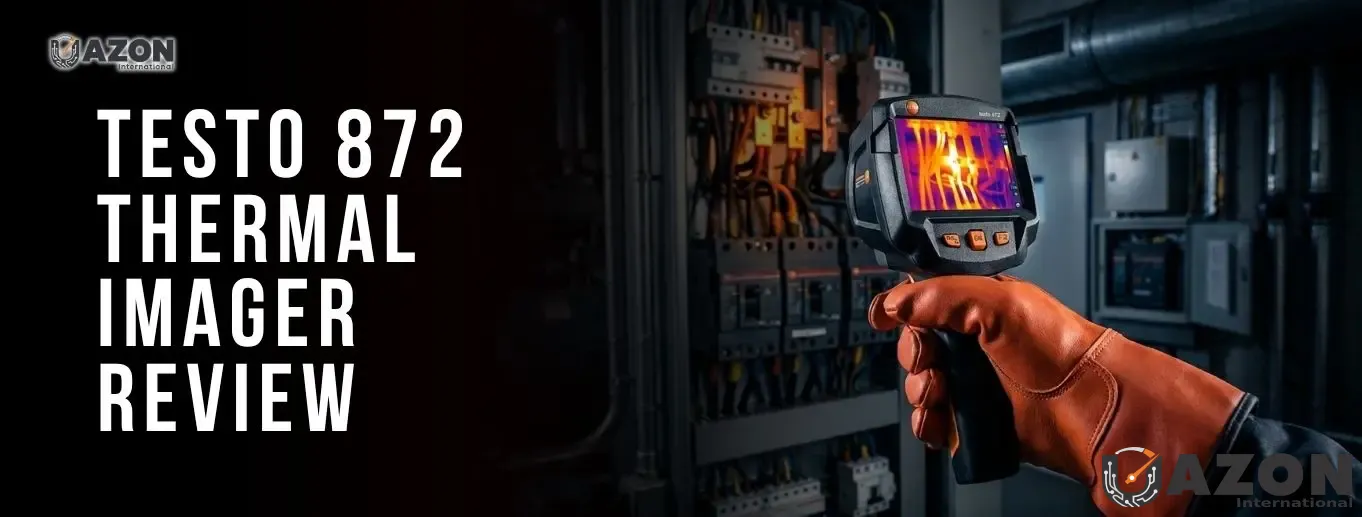
Guide to the Testo 872 Thermal Camera: Professional Thermal Inspection
Table of ContentsTesto 872 Thermal Camera: A Practical Guide to Professional Thermal Inspection
Thermal imaging has become one of the most powerful diagnostic tools in modern maintenance. Instead of waiting for equipment failure or visible damage, technicians can analyze temperature patterns to identify abnormal behavior early.
The Testo 872 thermal camera enables inspectors to capture precise thermal data and transform it into actionable maintenance decisions for electrical systems, buildings, and industrial equipment.
The Testo 872 thermal camera enables inspectors to capture precise thermal data and transform it into actionable maintenance decisions for electrical systems, buildings, and industrial equipment.
Step 1: Capturing Reliable Thermal Images
A successful thermal inspection begins with clear and stable thermal images. The Testo 872 provides:
- Infrared resolution: 320 × 240 pixels
- SuperResolution: 640 × 480 pixels
- Thermal sensitivity: < 0.05 °C
- Spectral range: 7.5 – 14 µm
High sensitivity allows technicians to detect very small temperature variations that often indicate developing faults.
Step 2: Analyzing Temperature Patterns
Thermal inspection is not only about identifying hot spots. Professionals analyze temperature distribution to understand system behavior.
- Hot spots in electrical connections
- Uneven heating in HVAC systems
- Cold bridges in building insulation
- Abnormal heating in motors and bearings
Step 3: Accurate Temperature Measurement
- Temperature range: -30 to +100 °C and 0 to +650 °C
- Accuracy: ±2 °C or ±2%
- Manual emissivity adjustment: 0.01 – 1
- testo ε-Assist: automatic emissivity and reflected temperature detection
Correct emissivity settings are essential for reliable temperature measurement, especially when inspecting reflective surfaces.
Step 4: Smart Analysis Functions
The Testo 872 provides several analysis tools to support professional diagnostics:
- Centre point measurement
- Hot and cold spot recognition
- Area measurement
- Delta T temperature comparison
- IFOV warner for measurement accuracy
Step 5: Documentation and Reporting
Inspection data becomes valuable only when it can be documented and shared.
- WLAN connection to the Testo Thermography App
- Smartphone as second display
- Remote camera control
- On‑site report creation and transfer
Designed for Field Inspections
- Protection class: IP54
- Operating temperature: -15 to +50 °C
- Battery operating time: approx. 4 hours
- Weight: 510 g
Thermography That Supports Smart Maintenance
Using the Testo 872, inspectors can capture accurate thermal images, analyze temperature patterns, and document inspection results efficiently.This workflow allows maintenance teams to detect early warning signs, reduce downtime, and maintain safer and more reliable systems.
FAQs
The Testo 872 thermal camera is used for professional thermal inspections in electrical systems, HVAC installations, industrial equipment, and building diagnostics to detect temperature anomalies and prevent failures.
The Testo 872 offers a 320 × 240 pixel infrared resolution, which can be enhanced to 640 × 480 pixels using SuperResolution technology.
The camera has two measuring ranges: -30 to +100 °C and 0 to +650 °C, suitable for both building inspections and high-temperature industrial applications.
The Testo 872 provides an accuracy of ±2 °C or ±2% of the measured value, whichever is higher.
Yes, it supports manual emissivity adjustment from 0.01 to 1 and includes testo ε-Assist for automatic emissivity and reflected temperature determination.
Yes, the Testo 872 features WLAN connectivity for use with the Testo Thermography App, allowing remote control, second display functionality, and on-site report generation.
The Testo 872 has a thermal sensitivity of less than 0.05 °C (50 mK), enabling detection of very small temperature differences.
Yes, it is designed for field inspections with IP54 protection, an operating temperature range of -15 to +50 °C, and approximately 4 hours of battery life.