Guide to Measuring Airflow with Pocket Anemometers: Testo 410‑1 vs 410‑2
Table of ContentsGuide to Measuring Airflow with Pocket Anemometers: Testo 410‑1 vs 410‑2
Airflow measurement is a fundamental task in HVAC maintenance, building diagnostics, and ventilation system balancing. Technicians often need a lightweight tool that can quickly verify air velocity at vents, diffusers, or ventilation outlets.
Pocket vane anemometers are designed specifically for these situations. They are compact, easy to carry, and capable of delivering quick airflow readings during routine inspections.
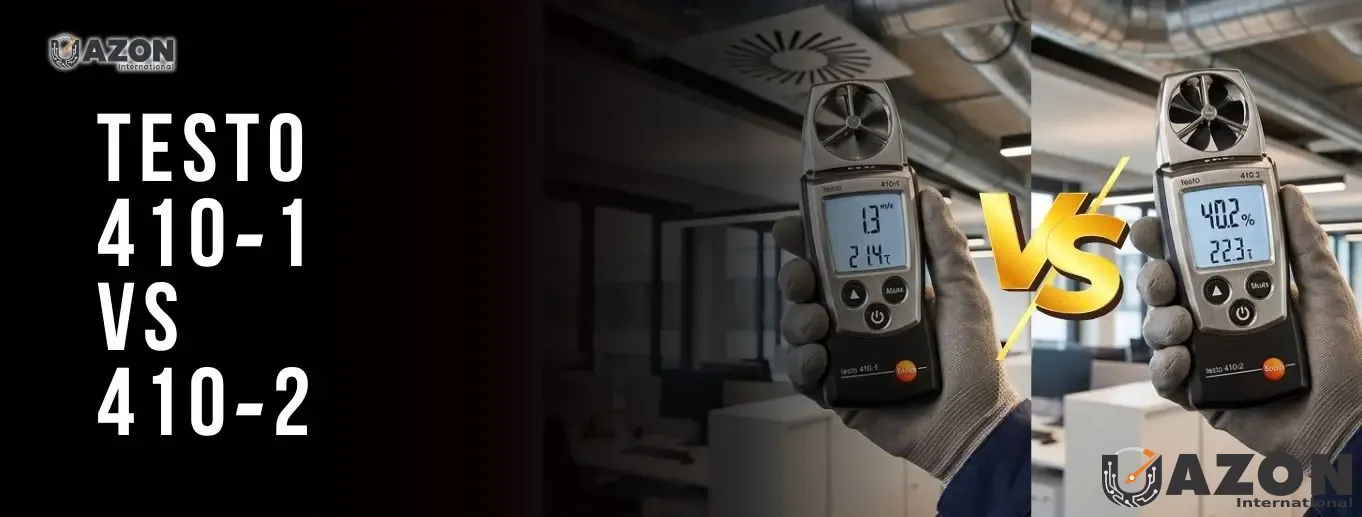
Two popular models for this purpose are the Testo 410‑1 and the Testo 410‑2. Both instruments are designed for portable airflow measurement, but they target slightly different measurement needs.
Why Pocket Anemometers Are Useful in HVAC Work
During HVAC inspections, technicians frequently need to check air movement at supply vents, return ducts, and ventilation openings. Carrying a large airflow instrument is not always practical.
This is where compact vane anemometers become extremely useful. Their integrated vane sensor allows them to measure air velocity quickly, making them ideal for routine field measurements.
Typical Applications
HVAC Vent Checks
Measure airflow at air outlets and ventilation grilles to verify that air distribution is balanced.
Indoor Climate Diagnostics
Quick airflow checks help technicians understand air circulation problems inside rooms.
Maintenance Inspections
Facility maintenance teams use portable airflow meters to verify ventilation performance.
Understanding the Testo 410 Series
The Testo 410 family focuses on portability and simplicity. These pocket-sized anemometers allow technicians to measure airflow without carrying bulky equipment.
The instruments include an integrated vane sensor that rotates when air passes through it, allowing the device to calculate air velocity and provide fast measurement results.
Comparison Overview
| Feature | Testo 410‑1 | Testo 410‑2 |
| Instrument Type | Pocket vane anemometer | Pocket vane anemometer |
| Portability | Compact handheld device | Compact handheld device |
| Typical Use | Quick airflow measurements | Airflow and climate measurements |
| Best For | Simple ventilation checks | More complete climate inspections |
Choosing the Right Model
When the Testo 410‑1 is the better option
- Quick airflow measurements at vents
- Routine HVAC inspection tasks
- Technicians who need a simple pocket tool
When the Testo 410‑2 may be preferable
- More advanced airflow diagnostics
- Indoor climate evaluations
- Technicians performing broader environmental checks
Why Compact Airflow Instruments Are Important
Modern HVAC technicians often work in tight mechanical rooms, ceilings, and ventilation shafts. Large measurement devices are not always practical in these environments.
Pocket vane anemometers solve this problem by offering fast airflow measurement in a lightweight and portable design.
Conclusion
Both the Testo 410‑1 and Testo 410‑2 are designed for quick airflow measurements in HVAC and building inspection tasks. The choice between them depends on the level of measurement capability required.
For technicians who need fast airflow checks in everyday work, these pocket anemometers provide a practical and reliable solution.