
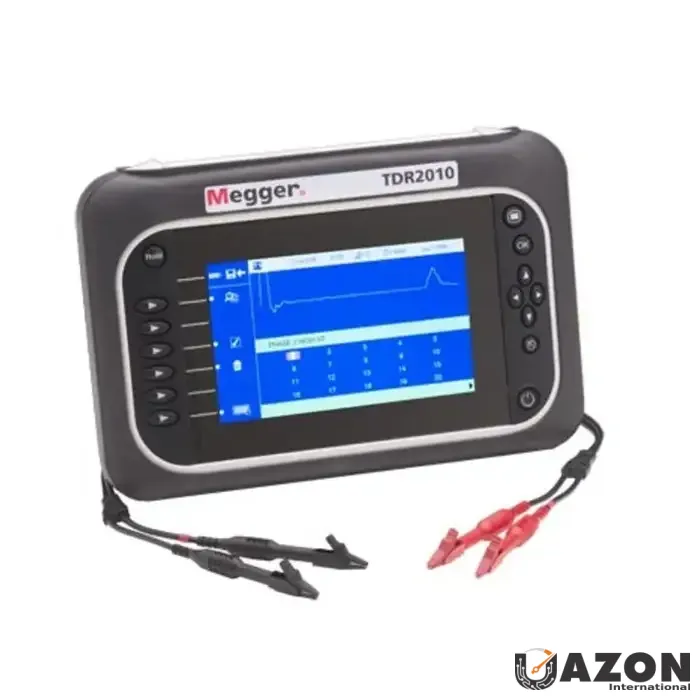




Description
About this model
Buy Megger TDR2010: The Ultimate Dual-Channel Reflectometer
When professionals need to detect faults in communication cables, pilot cables, or specific power supplies, the Megger TDR2010 stands out as a premier solution. As an advanced dual-channel time domain reflectometer, this instrument is engineered for precision and durability. If you are looking to buy the Megger TDR2010, you are investing in a tool designed specifically for the rigors of fieldwork. Unlike standard testers, this device combines robust physical construction with intelligent software features to streamline the troubleshooting process. For those comparing the Megger TDR2010 price, understanding its application-driven benefits is essential to making an informed purchasing decision.
Technical Features and Field Applications of the Megger TDR2010
The Megger TDR2010 is built to withstand harsh environments while delivering laboratory-grade accuracy. Before diving into the specific specifications, it is important to understand how these technical features translate to real-world field applications. The device is not merely a data collector; it is an active partner in fault location, designed to reduce setup time and improve diagnostic clarity.
- IP54 Rating for Rugged Environments: The Megger TDR2010 boasts an IP54 rating, ensuring protection against dust ingress and water splashes from any direction. This makes the device ideal for use in challenging outdoor conditions, such as construction sites or utility trenches, where standard equipment might fail. When you buy the Megger TDR2010, you are guaranteed a tool that maintains performance integrity even in unpredictable weather.
- CAT IV Safety Rating: Safety is paramount in high-energy environments. This reflectometer is CAT IV rated to 150 V, allowing it to be used safely on distribution cables and low-voltage power supplies. This rating provides peace of mind for technicians working near potential energy sources, ensuring that the instrument offers protection against transient overvoltages.
- Dual-Channel Capability: The TDR2010 features two independent channels, allowing users to compare traces from two different cables or two different pairs within the same cable simultaneously. This capability is critical for identifying intermittent faults or verifying cable integrity across multiple lines without switching connections repeatedly.
- Intelligent Auto Setup: For rapid deployment, the ‘Auto setup’ function expedites the process of obtaining useful traces. This feature automatically adjusts the pulse width and range, allowing technicians to focus on analyzing the signal rather than configuring the instrument. It is particularly beneficial for users who need to perform quick checks across multiple cables.
- AutoFind and FindEnd Functions: Interpreting TDR traces can be complex. The ‘AutoFind’ and ‘FindEnd’ functions assist by automatically identifying and marking discontinuities and cable ends on the display. This reduces the cognitive load on the operator and minimizes the risk of human error in fault detection.
Advanced Diagnostic Tools and User Controls
While the Megger TDR2010 offers powerful automation, it also provides extensive manual controls for expert users. These features allow for fine-tuning the instrument to pinpoint difficult or subtle faults that automated systems might miss. The following tools are integrated into the device to enhance diagnostic precision and workflow efficiency.
- Manual Override for Expert Tuning: Expert users can manually override automatic settings to adjust pulse width, range, and gain. This flexibility is essential when dealing with complex cable networks or non-standard cable types where generic settings may not yield accurate results.
- Distance-Dependent Gain: Signal attenuation is a common issue in long cable runs. The Megger TDR2010 includes distance-dependent gain, which automatically counteracts signal loss over distance. This ensures that faults at the far end of a cable are as visible as those near the beginning, providing a balanced and clear trace across the entire length.
- Step Function for Near-End Faults: Detecting faults close to the testing point can be challenging due to the high amplitude of the initial pulse. The step function improves the detection of near-end faults by altering the pulse characteristics, making these critical defects visible on the display.
- Overlaying Traces for Comparison: The new screen layout allows for overlaying traces from different tests or channels. By superimposing a known good trace over a faulty one, technicians can instantly spot deviations. This visual comparison is invaluable for locating intermittent faults or verifying repairs.