



Description
About this model
Buy Megger STX40 Portable Fault Location System for High-Voltage Cable Testing
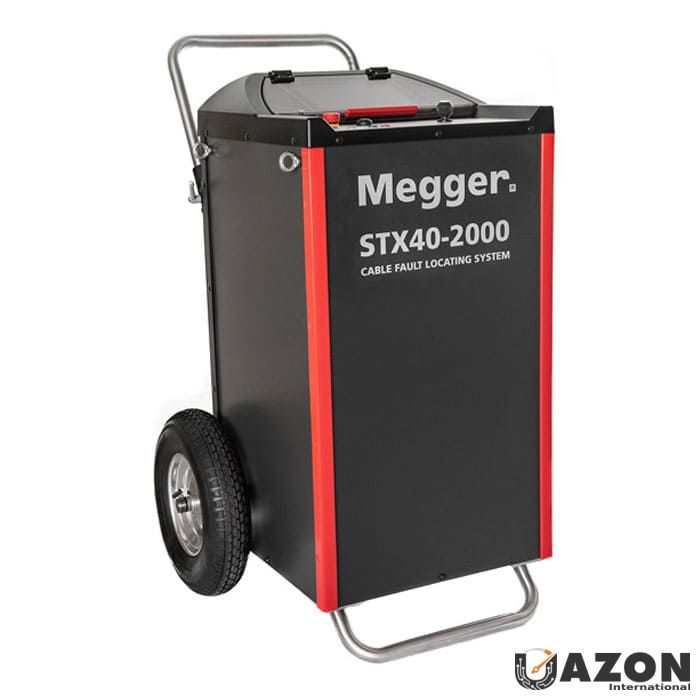
Locating faults on high-voltage cables requires precision, reliability, and sufficient energy delivery to overcome insulation resistance. The Megger STX40 Portable Fault Location System is engineered to meet these demands, offering a fully integrated solution for proof testing, analysis, and pinpointing faults on extruded low- and medium-voltage cables. As one of the most powerful and modern portable systems on the market, the STX40 combines a 40 kV DC source with a potent high-frequency burner, making it equally effective on PILC cables as it is on XLPE and EPR-insulated types. For professionals seeking the Megger STX40 price or looking to buy a system that maximizes field efficiency, this unit represents a significant investment in diagnostic capability.
Technical Features and Field Applications of the Megger STX40
The Megger STX40 is designed with a focus on operational safety and ease of use in harsh outdoor environments. Its robust construction and intuitive interface allow technicians to perform complex fault location sequences without extensive setup time. The system is fully automatic, featuring motorized HT switches that can be controlled via a precise rotary knob or an industrial-grade color touchscreen. This dual-control mechanism ensures that the operator can manage high-voltage functions safely and efficiently, whether wearing gloves or working in tight spaces.
Below are the key technical features and their practical field applications:
- Portable and Weather-Resistant Design: The unit boasts an IP 43 protection class, making it weather-resistant and rainproof for reliable outdoor operation. Weighing approximately 119 kg (262 lbs) in its standard version, it is engineered for true portability, allowing teams to transport it easily to remote fault sites.
- User-Friendly Interface: Operation is streamlined through a "turn and click" single rotary knob interface. This design minimizes the learning curve, enabling technicians to navigate menus and adjust settings quickly, which is critical when time is limited during fault location missions.
- High-Energy Surge and Thump Capabilities: The system delivers a surge/thump energy of 2,000 Joules across standard levels of 0–8 kV, 0–16 kV, and 0–32 kV. This substantial energy output is essential for effectively burning through high-resistance faults and creating a clear signal for prelocation methods.
- Versatile HV Source for Testing and Burning: With a DC testing capability up to 40 kV and burning up to 40 kV, the STX40 handles a wide range of cable types. The high-frequency burner provides precise current control, with maximum outputs ranging from 850 mA at 5 kV to 100 mA at 40 kV, ensuring efficient fault burning without damaging healthy cable insulation.
- Advanced Prelocation Methods: The system supports multiple prelocation techniques, including Inductive ARM with Multishot, ICE (Impulse Current Method), and DECAY. These methods allow technicians to narrow down fault locations accurately before proceeding with pinpointing, saving time and reducing excavation costs.
- Integrated Safety Circuits: Built-in safety features include earth connection monitoring (F-Ohm) and touch potential monitoring (F-Voltage). These circuits continuously check for safe grounding conditions and prevent accidental exposure to hazardous voltages, adhering to strict industrial safety standards.
- Full TDR Control: The STX40 offers complete Time Domain Reflectometer (TDR) control of all HV functions. This integration allows for seamless switching between testing modes and real-time analysis of cable conditions, enhancing the accuracy of fault distance measurements.
Performance Specifications and Operational Efficiency
Understanding the detailed specifications of the Megger STX40 is vital for assessing its suitability for specific testing environments. The system is built to deliver consistent performance across a wide temperature range, making it adaptable to various climatic conditions. Its power supply and output capabilities are designed to meet the rigorous demands of utility and industrial cable maintenance.
The following specifications highlight the operational parameters that contribute to the system's efficiency:
- Insulation Testing Ranges: The unit provides voltage ranges of 5 kV, 10 kV, 15 kV, and 20 kV for insulation resistance measurements, with a measuring range up to 650 MΩ. This allows