




Description
About this model
Megger FREJA549 Relay Test System Overview
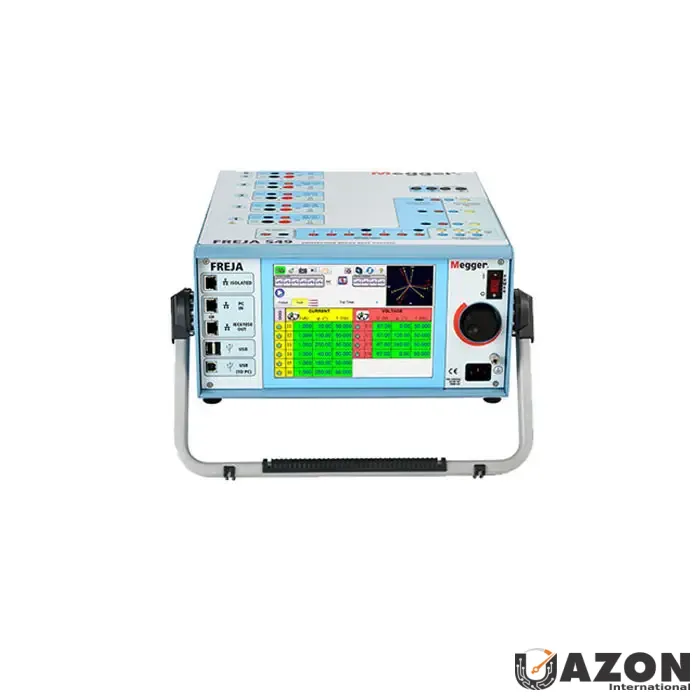
The Megger FREJA549 relay test system is a versatile, lightweight, and portable device designed for the secondary testing of protection relays. This comprehensive solution provides up to nine current channels, allowing for complex differential relay testing in a single unit. Operators can utilize the built-in touch screen interface running FREJA Local for standalone, manual operation, or they can achieve complete automation through a computer using the FREJA Win Software. The integrated user interface represents Megger’s second generation of automatic and semi-automatic manual interfaces, prioritizing ease of use and workflow efficiency.
Engineered for high-performance field applications, the FREJA549 features a high compliance voltage specifically tailored for testing high impedance earth fault relays. It also boasts substantial current capabilities to test all types of overcurrent relays, including electromechanical, solid-state, and numerical-based units. Furthermore, this system handles voltage-controlled, voltage restraint, and directional overcurrent relays with precision. When you are looking to buy the Megger FREJA549, you are investing in a rugged, future-proof solution that adapts to various testing environments.
Technical Features and Field Applications of the Megger FREJA549
Understanding the technical features of the Megger FREJA549 is essential for engineers who require precise and reliable relay testing. This section details the specific capabilities that make this device a top choice for substation maintenance and commissioning. The following features highlight why the Megger FREJA549 price offers exceptional value for professional testing scenarios.
- High-Current Output for Versatile Testing: The system delivers up to 60 Amps per phase with a high power output of 300 VARMS. This capability ensures that electromechanical and solid-state overcurrent relays are tested accurately under load conditions, providing reliable trip verification.
- Multi-Channel Configuration: The unit provides up to nine currents for testing transformer and bus differential relays. With four voltage channels and three current channels, plus convertible voltage channels providing one voltage and six currents, the FREJA549 offers the flexibility needed for complex protection schemes.
- Standalone and Automated Operation: Featuring an intuitive high-resolution graphic touchscreen, the system can operate without a PC. This standalone capability is ideal for field technicians who need to perform quick checks. For complex, automated sequences, the fully automated testing using FREJA Win software streamlines the entire process.
- Advanced Synchronization and Communication: The system supports dynamic GPS satellite synchronized end-to-end testing, which is critical for longitudinal protection schemes. Additionally, it includes IEC 61850 testing ability, ensuring compatibility with modern digital substations and Ethernet-based protection relays.
- Portable and Rugged Design: Despite its high power output, the FREJA549 is designed to be lightweight and portable. This durability allows for easy transport between test sites, reducing setup time and increasing productivity for field crews.
Comprehensive Output Specifications and Performance
To maximize the utility of the Megger FREJA549, it is crucial to understand its output specifications. These detailed metrics define how the unit performs under various load conditions, ensuring that you select the right parameters for every test object. The following data outlines the per-channel output capabilities, which are vital for calculating the Megger FREJA549 price based on application requirements.
The unit’s per-channel output is designed for precision across a wide range of currents and voltages. From low-level fault simulation to high-current breaker testing, the FREJA549 maintains stability and accuracy. This performance spectrum ensures that whether you are testing a sensitive numeric relay or an older electromechanical unit, the test signals remain pure and reliable.