




Description
About this model
Buy Megger BITE2
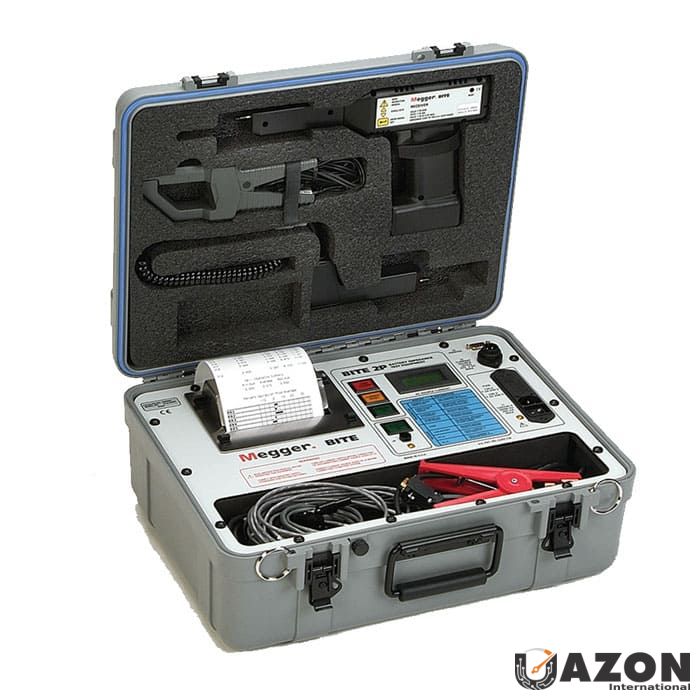
The Megger BITE2 is an advanced battery impedance testing device designed to evaluate the condition of lead-acid and nickel-cadmium cells up to 7000 Ah. This essential tool is crucial for maintaining and monitoring battery systems in telecommunications, power utilities, and other critical industries. The Megger BITE2 excels at delivering detailed diagnostics, helping to prevent battery failures, and ensuring the reliable operation of backup power systems.
A standout feature of the Megger BITE2 and BITE2P is their ability to perform Pass/Warning/Fail assessments. This functionality allows users to set a baseline value against which the condition of each battery is measured. The equipment then generates results that indicate whether the battery’s performance is within acceptable limits (Pass), near the threshold requiring attention (Warning), or outside acceptable parameters (Fail). This advanced analysis helps technicians prioritize maintenance tasks and make informed decisions about battery replacements, enhancing the overall efficiency and safety of the power system.
Additionally, the Megger BITE2 and BITE2P are equipped with advanced printing functions, enabling immediate output of on-site test results. This feature is handy for creating instant reports that can be shared with clients or used for further assessment by engineering teams.
Technical Features and Field Applications of the Megger BITE2
The Megger BITE2’s most important specification is its ability to test battery systems up to 7000 Ah. It offers precise impedance and voltage measurements, ensuring optimal battery health and performance across large systems. When you are looking to buy the Megger BITE2, you are investing in a tool that combines robust field performance with laboratory-grade accuracy.
Understanding the technical specifications is vital for making an informed purchase. The following details outline the operational capabilities that make this device a industry standard for battery maintenance.
Transmitter and Source Output
The transmitter is the heart of the BITE2 system, providing the necessary current to measure impedance accurately. It is designed to handle significant voltage loads while maintaining safety and precision.
- Supply Voltage Options: The unit operates on 100 to 130 V or 210 to 250 V at 50/60 Hz, with a maximum power consumption of 200 VA.
- Source Output Current: It delivers a nominal 10 A output at 50/60 Hz operation, which is sufficient for testing large battery banks.
- Maximum Total Voltage: The device handles up to 275 V DC at the current source leads. For larger systems exceeding this limit, the battery can be sectioned to accommodate the specification.
Receiver Accuracy and Precision
The receiver unit is engineered to capture subtle electrical variations, allowing for precise diagnostics. This level of accuracy is critical when determining the remaining useful life of a battery cell.
- Impedance Accuracy: The AC impedance measurement boasts an accuracy of 5% +1 LSD (Least Significant Digit).
- DC Voltage Accuracy: Voltage readings are accurate to ±(0.5% of reading +1 LSD), ensuring reliable baseline data.
- Precision Levels: The device offers better than 0.5% one sigma precision, making it suitable for high-stakes environments where data integrity is non-negotiable.
Voltage and Impedance Ranges
Versatility in measurement ranges allows the BITE2 to test a wide variety of cell sizes and chemistries without requiring multiple devices.
- Voltage Range and Resolution:
- 1 to 2.500 V DC with 1 mV resolution.
- 2.5 to 25.00 V DC with 10 mV resolution.
- Impedance Range and Resolution:
- 0 to 1.000 mΩ with 1µΩ resolution.
- 1 to 10.00 mΩ with 10µΩ resolution.
- 10 to 100.0 mΩ with 0.1µΩ resolution.