
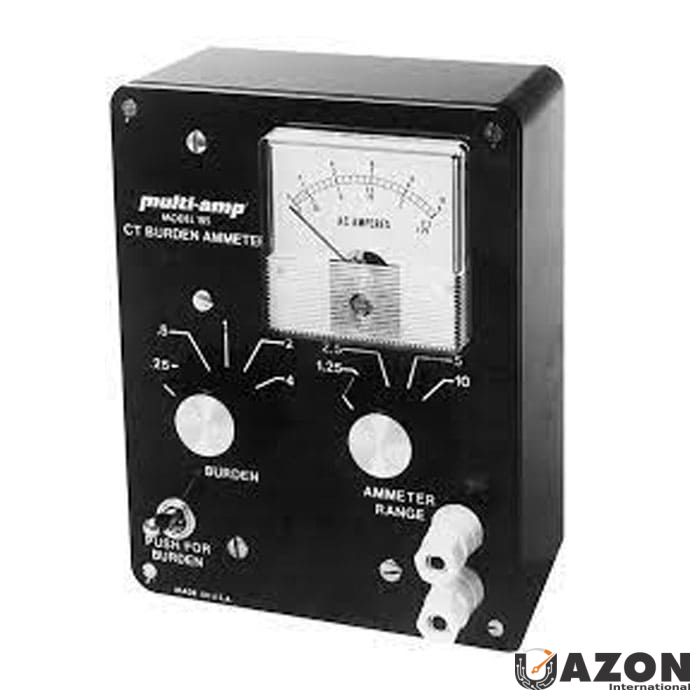




Description
About this model
Why The Megger BA185 Is The Best Price For Field Transformer Testing
When evaluating the health of current transformer (CT) installations, precision and portability are paramount. The BA-185 Current Transformer Burden Ammeter stands out as a rugged, portable instrument specifically engineered for demanding field conditions. Professionals looking to buy high-quality test equipment often prioritize devices that simplify complex diagnostics without sacrificing accuracy. This instrument is designed to detect critical faults that can compromise electrical safety and metering integrity, making it an essential tool for utility maintenance teams and industrial electricians. By offering a comprehensive solution for field testing, this device ensures that current transformers operate within their specified parameters, preventing costly downtime and ensuring compliance with industry standards.
Understanding the value proposition of this tool involves looking beyond its physical build and examining its operational capabilities. When considering the Megger BA185 price, potential buyers are investing in a device that consolidates multiple testing functions into a single, handheld unit. It addresses the common challenge of verifying CT installations in the field, where access to laboratory-grade equipment is impossible. Whether you are troubleshooting a substation or validating new installations, the ability to perform immediate, accurate tests is invaluable. This article explores the technical features and field applications of the Megger BA185, providing a detailed look at why it remains a preferred choice for professionals worldwide.
Technical Features and Field Applications of the Megger BA185
The design philosophy behind the Megger BA185 centers on robustness and user-friendly operation in harsh environments. As a portable instrument, it withstands the rigors of field use while delivering laboratory-grade precision. The device is engineered to test current transformer installations for a variety of faults that are often invisible to the naked eye. Before delving into the specific test capabilities, it is important to understand the context of these applications. A current transformer’s performance relies heavily on the integrity of its secondary circuit, and even minor anomalies can lead to significant measurement errors or safety hazards.
The following list outlines the specific conditions and faults that the Megger BA185 is designed to detect during field testing. These applications cover the most common failure modes encountered in current transformer secondary circuits, providing a comprehensive diagnostic toolkit for the operator:
- Short-circuited secondary turns within the transformer winding.
- Short-circuited primary turns that affect the transformer’s ratio.
- Short-circuited secondary wiring external to the transformer.
- High-resistance connections caused by corrosion or loose terminals in the secondary circuit.
- Grounding of the secondary winding when mounted on a grounded structure, which creates unintended current paths.
- Grounding of a normally ungrounded wire, altering the circuit’s electrical characteristics.
Understanding CT Ratio Stability and Burden Impact
To effectively use the Megger BA185, it is crucial to understand the theoretical principles governing current transformer behavior. Within the accuracy limits of a CT, a good current transformer should exhibit a negligible change in ratio when a secondary burden is added. This stability is a hallmark of a healthy transformer. The primary effect of adding burden to a good CT is a rise in the secondary voltage, which compensates for the additional impedance without altering the current ratio significantly. This behavior is fundamental to the testing methodology employed by the BA185.
Conversely, if one or more turns of a CT are shorted, the electrical dynamics change drastically. A substantial amount of the total available ampere-turns is diverted into the shunt path created by the short circuit. This diversion means that the current delivered to the circuit connected to the CT is less than the CT’s total secondary current. Consequently, when the proper burden within the ammeter is added in series with a good CT, the current indicated by the ammeter should only decrease by a few percent. The Megger BA185 leverages this principle to identify faults; a significant deviation in current indicates the presence of shorted turns or high-resistance connections.
Operational Specifications and Measurement Ranges
The Megger BA185 is not just a theoretical tool but a practical instrument with specific operational ranges tailored for field versatility. When evaluating the Megger BA185 price, buyers should consider the flexibility offered by its multiple ammeter and burden ranges. The device allows operators to select the appropriate range for the specific CT under test, ensuring optimal resolution and accuracy. This versatility is essential when dealing with transformers of varying ratings and secondary configurations.
Below are the key technical specifications that define the performance envelope of the Megger BA185. These specs are designed to cover a wide spectrum of field scenarios, from low-current monitoring circuits to high-current protection