Megger TDR1000/3 vs TDR1000/3P - Cable Fault Locator Comparison
Table of ContentsMegger TDR1000/3 vs TDR1000/3P
A practical and technical comparison of two compact Megger handheld TDR instruments designed for metallic cable fault location. This guide explains how both devices perform in real field diagnostics while also reviewing their verified technical specifications.
Overview: Choosing the Right Handheld TDR
For engineers working in telecom infrastructure, industrial control systems, and building networks, locating cable faults quickly is essential. Handheld Time Domain Reflectometers (TDRs) make this process easier by sending a fast pulse into a cable and analyzing reflections caused by impedance changes.
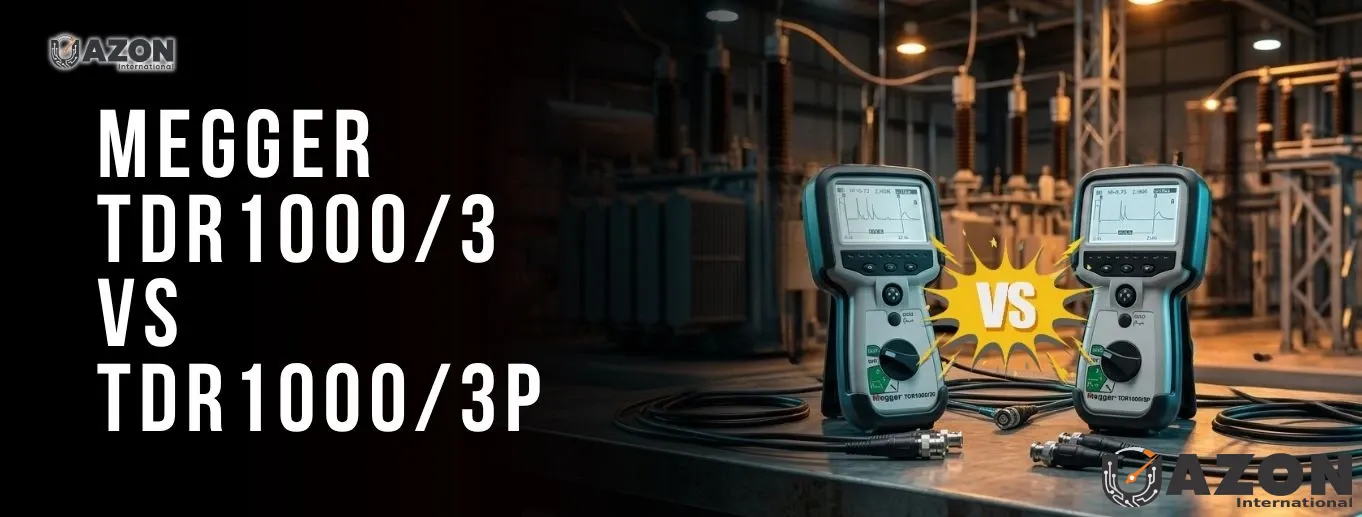
Two widely used portable instruments in this category are the Megger TDR1000/3 and Megger TDR1000/3P. Both models are compact field tools designed for locating faults in metallic cables while offering high measurement accuracy and simple operation.
From a measurement standpoint, the two instruments share the same core technical platform: identical maximum range, high‑resolution measurement capability, and the same ultra‑fast pulse performance. The real comparison therefore focuses on usability features, workflow capabilities, and how each model presents diagnostic functions.
Field Usability
Both instruments are designed for technicians who work in real field environments. Their lightweight handheld format allows easy use in cable vaults, telecom cabinets, and industrial panels.
The AUTO setup function helps operators begin testing quickly by automatically selecting suitable gain and pulse parameters. This removes the need for complicated manual configuration during urgent troubleshooting.
Trace Analysis
A key advantage of handheld TDRs is the ability to visually interpret reflections from cable faults. Using a fast 2 ns pulse width, both models can detect impedance changes very close to the test point.
Technicians can observe reflections caused by cable joints, connectors, or damaged sections along the cable path.
Durability
Field instruments must survive dust, moisture, and transportation between job sites. Both devices feature an IP54 protection rating, meaning they are resistant to dust ingress and splashing water.
Power is supplied using standard AA batteries, which is especially practical for remote maintenance environments.
Shared Technical Specifications
5 km / 15 kft
0.1 m
0.2 – 0.99
2 ns
Backlit 256 × 128 LCD
IP54
TNV‑3 telecom circuits or 150 V CAT IV
Five AA batteries
TDR1000/3 vs TDR1000/3P Comparison
| Feature | TDR1000/3P | TDR1000/3 |
|---|---|---|
| Product Type | Handheld TDR | Handheld TDR |
| Maximum Range | 5 km | 5 km |
| Resolution | 0.1 m | 0.1 m |
| Pulse Width | 2 ns | 2 ns |
| Trace Function | Trace HOLD | Trace HOLD + live trace overlay |
| Operational Features | AUTO setup | AUTO gain & pulse, dual cursors, auto impedance |
Both the Megger TDR1000/3 and TDR1000/3P are compact handheld reflectometers designed for locating faults on metallic cables. Their fundamental measurement specifications are essentially identical, including the 5 km range, 0.1 m resolution, velocity factor range, and ultra‑fast 2 ns pulse.
The main practical difference lies in feature presentation and workflow tools. The TDR1000/3 highlights additional operational features such as live trace overlay, dual cursors, and automatic measurement configuration options.
For technicians, utilities, and telecom engineers, both instruments provide reliable cable diagnostics. The final selection depends on whether your workflow benefits from the expanded operational features highlighted in the TDR1000/3 model.