Megger DET4TC2 Earth Ground Tester Review: Features, Benefits & Field Use
Table of ContentsUnderstanding Earth Resistance Testing with the Megger DET4TC2
A technical overview of how modern earth testing instruments such as the DET4TC2 support accurate grounding verification in electrical installations.
Why Ground Resistance Testing Matters
Electrical grounding systems play a critical role in protecting equipment and personnel from electrical faults. Without proper earthing, fault currents and lightning surges may not dissipate safely into the soil, increasing the risk of equipment damage and electrical hazards.
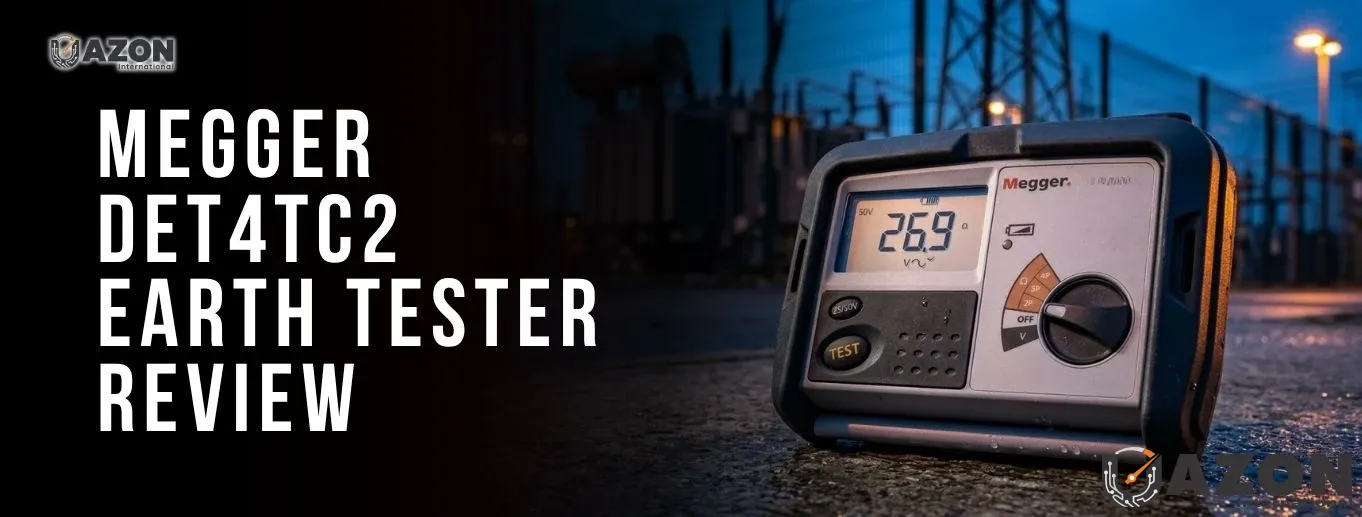
To verify the integrity of grounding systems, engineers rely on dedicated instruments known as earth resistance testers. One widely used device in this category is the Megger DET4TC2, a portable tester designed for field engineers who need dependable measurements in real-world conditions.
How Earth Testers Evaluate Ground Systems
Ground resistance testing generally relies on injecting a small test current into the soil through auxiliary probes and measuring the resulting voltage drop. By applying Ohm’s law, the tester calculates the resistance between the grounding electrode and the surrounding earth.
Instruments like the DET4TC2 support multiple test configurations to adapt to different site conditions. These measurement techniques allow technicians to obtain reliable readings even when soil conditions, nearby structures, or electrical interference could otherwise distort the results.
2‑Point Testing
A simplified method used when an existing grounding system is already present. It measures the resistance between two electrodes and is often used for quick verification tasks.
3‑Point Fall‑of‑Potential
One of the most widely accepted techniques for grounding analysis. It uses two auxiliary stakes to determine the resistance of a single grounding electrode with improved accuracy.
4‑Point Soil Resistivity
Engineers use this configuration to study soil characteristics before installing a grounding system. The method helps determine how easily electrical current flows through the soil.
Key Characteristics of the DET4TC2
The DET4TC2 belongs to a family of portable digital ground testers intended for outdoor measurements. Its construction focuses on durability and ease of operation so technicians can work efficiently in substations, industrial plants, or infrastructure projects.
- Supports multiple test configurations including 2‑point, 3‑point, and 4‑point measurements.
- Designed for field environments with an IP54 protective enclosure.
- Battery-powered operation using standard AA cells for convenient site work.
- Noise rejection technology helps maintain stable readings in electrically noisy environments.
- Complies with IEC 61557‑5 standards for earth resistance measurement instruments.
Where Ground Testing Instruments Are Used
Earth resistance testers are essential tools in many electrical engineering tasks. Typical applications include verifying grounding systems in power distribution facilities, inspecting lightning protection networks, and evaluating soil conditions before installing new earthing electrodes.
A Reliable Tool for Grounding Verification
Accurate ground resistance measurement is essential for electrical safety and system reliability. Portable instruments such as the Megger DET4TC2 help engineers perform these evaluations efficiently in field environments where dependable results are critical.